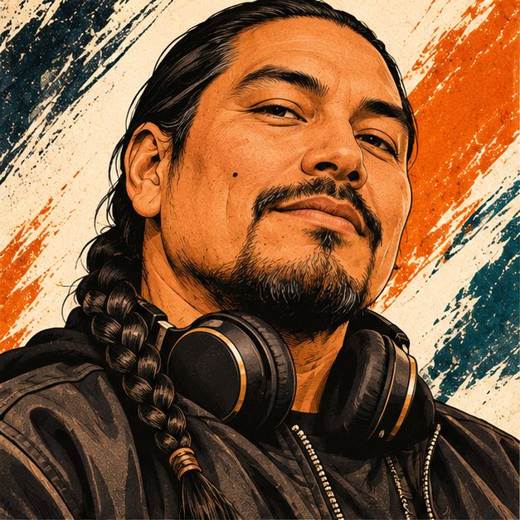
The album title says a lot before the first verse. Spirits Back, released in June 2026, is the debut album by PINDN, a Victoria-based Kwakwa̲ka̲'wakw and Nuu-chah-nulth MC. The artist describes hip-hop as a route toward healing and a continuation of storytelling practices, not an escape from them.
There is a tendency in music coverage to flatten Indigenous hip-hop into a single message. PINDN's own presentation points somewhere more personal: the work grows out of recovery, self-expression and a desire to make language and experience audible in an art form that reaches young listeners.
The details behind the record
The Bandcamp release credits matter. Most tracks were recorded in 2025 at Haus of Owl Creation Lab on Lək̓ʷəŋən Territory, with mixing and mastering by Cody Baresich at Circle A Studios. The album lists La-Nai Gabriel as producer and notes Kwak'wala translation work for its introduction and outro. The project also credits support from the First Peoples' Cultural Council.
Those specifics give us a better sense of the record than a generic “emerging rapper” label. An album is a network of writers, engineers, language contributors, images, rooms and late-night decisions. Here the credits tell a story of local infrastructure being used to put a distinct voice on record.
How to discover the music
The most direct starting point is Spirits Back itself, where the complete track list and credits are available to listeners. Listen for the way the album moves between individual testimony and connection to place. PINDN is on our radar because the work has something specific to say—and because a debut should be heard before it is judged by a follower count.
What makes this debut different
The first thing to understand about Spirits Back is how deliberately it was assembled. Released on June 26, 2026, the record was tracked mostly in 2025 at Haus of Owl Creation Lab on lək̓ʷəŋən territory. Track eleven was recorded at Circle A Studios, where Cody Baresich also handled mixing and mastering. Those are not trivial credits; they identify the local creative infrastructure behind a record that would be easy to reduce to a single artist name.
Producer La-Nai Gabriel, guest collaborators, and Kwak’wala language work all appear in the credits. Ye-Kue-Klas (David Sonny Wallas Hanuse) translated the introduction and outro, while HawLii contributed to the writing of the chorus on “Ma.” Rather than being decorative additions, those details tell listeners that language, family relationships and community participation are part of the project’s construction. The release also credits funding from the First Peoples’ Cultural Council.
Three tracks to approach it through
“A Mourning Song,” featuring Guy Louie Jr., points toward grief and remembrance. “Pindian” foregrounds the artist’s voice and the everyday specificity of his writing; it is a useful introduction to his irreverent side. “Ma,” with HawLii, places family at the centre. Taken together, these songs suggest a far wider emotional register than the phrase “Indigenous rapper” can communicate on its own.
There is no requirement to know the cultural references in advance to hear the difference in perspective. The album offers a way into them. That makes Bandcamp especially useful here: the credits, complete track listing and artist-supplied context live alongside the music. Readers can support the release directly instead of relying entirely on algorithmic discovery.
The wider question
PINDN’s biography describes more than five years of recovery and presents lyric writing as a form of healing. We are careful not to turn that experience into a marketing slogan. What interests us is the craft that follows from it: an independent MC using rhyme and recording to put a personal worldview into circulation.
For an emerging artist, an independently released full-length record is already an ambitious act. Spirits Back deserves a close listen because it can be approached as a complete piece of work, with collaborators, sequence and intention—not only as a streaming single.
Hear it. See it. Follow the work.
A profile is a starting point. Experience the actual song, performance, release or project through the creator’s own channels.
Reported from credited public interviews, company biographies, festival or institutional records and published filmographies. Vibe Tribe did not conduct an exclusive interview for this story.